
You press the brake pedal, and it sinks a little further than it did. Not a lot. Just enough that you notice, then talk yourself out of it. Doha traffic does that to a driver: stop, crawl, stop again, and a soft pedal starts to feel normal because everything around you moves the same way.
It is not normal. A spongy or slowly sinking brake pedal is often the first sign of brake piston seal failure, and in Qatar’s heat, it tends to show up faster than most drivers expect.
What the Brake Piston Seal Actually Does
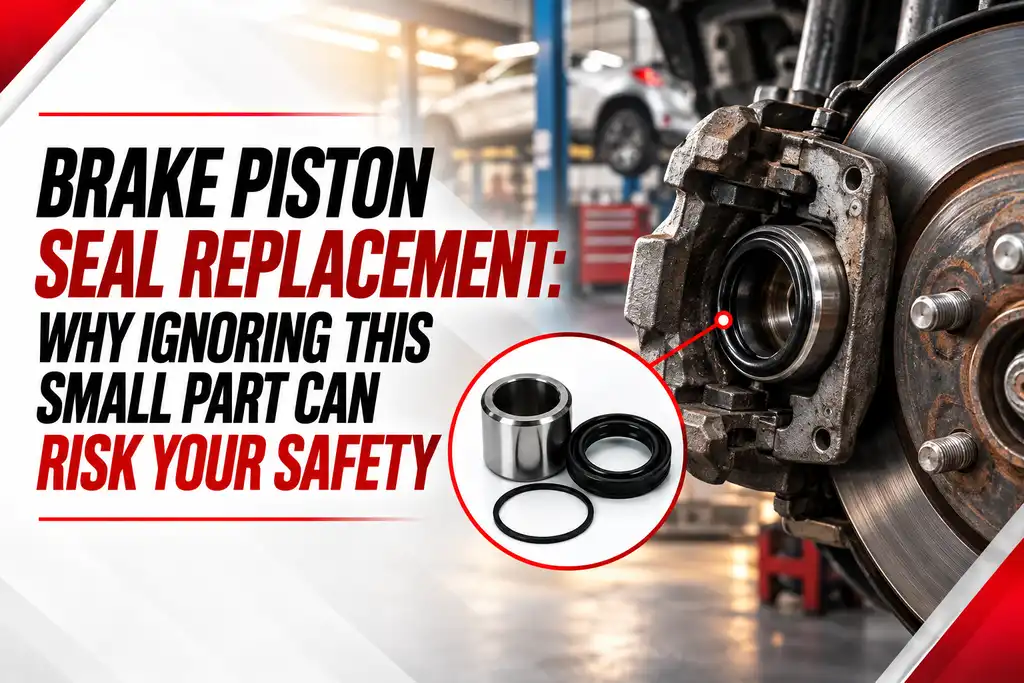
Every brake caliper piston sits inside a rubber seal that does two jobs most drivers never think about. It keeps brake fluid from leaking past the piston, and it pulls the piston back a fraction after each stop, so the pad releases cleanly instead of dragging against the disc.
That seal is small. It is also under constant thermal stress, sitting a few centimetres from a disc that can reach several hundred degrees during hard braking. Add Doha’s ambient summer heat and the seal is working from an already elevated baseline before the car has even moved.
Over time, the rubber hardens and loses its grip on the piston. Once that happens, two failure patterns tend to follow:
- A slow fluid leak, as the seal stops holding pressure and brake fluid seeps past it.
- A stuck or dragging piston, as the hardened seal can no longer retract the piston after braking.
Both start quiet. Both get worse the same way: gradually, until a specific moment makes them undeniable.
Why Qatar’s Roads Accelerate This Specific Failure
Heat is the obvious factor, but it is not the only one. Three conditions here work against a caliper seal at the same time, and each one shortens its working life on its own.
Ambient and braking heat stack: A seal rated for general use assumes some cooling between hard stops. Qatar’s summer air temperature removes a good part of that cooling margin before the disc even heats up.
Stop-start city driving multiplies cycles: Doha’s traffic pattern, particularly around the Corniche and the ring roads at peak hours, means calipers cycle through heat and cool far more often per kilometre than they would on a steady highway run. Each cycle flexes the seal. More cycles means more fatigue, sooner.
Fine dust works into every seal boundary: Qatar’s dust is abrasive at a microscopic level. It settles on the caliper, works past the dust boot, and sits against the piston seal, wearing at the exact surface that needs to stay smooth to seal properly.
None of these three would be a serious problem alone: Together, they are the reason a brake caliper seal replacement that might be a 60,000-kilometre conversation elsewhere often becomes a live issue much sooner on Doha roads.
The Warning Signs Worth Acting On
A brake pedal feels spongy for a reason, and the reason is almost always mechanical, not imagined. Left unchecked, that reason often ends in visible brake fluid leakage at one corner of the car.
- A pedal that sinks slightly under sustained pressure, particularly in traffic or at a long red light, points to fluid escaping past a failing seal.
- A brake fluid leak visible near a wheel, sometimes just a faint wet patch on the inside of the rim or a drop on the ground under one corner, is not something to top up and ignore.
- A car that pulls to one side under braking often means one caliper piston has seized while the others still release normally, an early sign that the caliper needs attention.
- A burning smell after a short drive, especially without hard braking, can mean a dragging pad from a piston that will not retract.
- Uneven pad wear, one side worn far more than the other, is frequently the physical record of a seal that stopped doing its job months earlier.
Any one of these on its own is worth a brake system inspection. Two together are worth booking one this week, not next month.
The Part Where Waiting Costs More
A failing piston seal rarely stays a piston seal problem. Fluid loss from a leaking seal drops brake fluid level, which affects every corner of the braking system, not just the one caliper. A seized piston keeps a pad clamped against a disc long after the pedal is released, which wears that disc unevenly and generates heat the system was never designed to handle continuously.
Genuine brake caliper piston seal replacement, caught early, is a contained repair. Left to run, it becomes a disc replacement, sometimes a caliper replacement, and occasionally a full brake system repair involving a brake fluid leak repair that means bleeding the entire system to clear air introduced by low fluid. The part that started this is the cheapest one in that chain.
What a Proper Brake Caliper Seal Replacement Involves
A brake caliper repair done correctly, the kind of brake piston seal repair that actually holds, is not a five-minute swap. The caliper comes off, the piston is inspected for scoring or corrosion (a seal will not seal properly against a damaged piston surface, however new the seal is), the bore is cleaned, and the new seal seats before the piston goes back in. Brake fluid gets checked and topped or bled as needed, since a leak or a stuck piston rarely leaves the fluid untouched.
This is also where genuine parts matter more than most drivers assume. A seal that is a fraction out of spec, or made from rubber not rated for this heat range, fails again within months. It is a false economy that shows up as a repeat visit, usually at a worse moment than the first one.
AMTTS has been diagnosing exactly this pattern of brake caliper piston seal failure across Honda, Toyota, Nissan, Kia, and Mitsubishi models on Doha roads for more than 35 years, with transparent pricing quoted before any work starts. No surprise line items once the caliper is already off the car.
If your pedal has felt different for more than a week, message AMTTS on WhatsApp at +974 3352 6445 to book a proper brake piston seal replacement before a contained repair turns into a bigger one.

FAQs
What is brake piston seal replacement?
Brake piston seal replacement is the process of removing a caliper’s worn rubber seal and fitting a new one so the piston holds pressure and retracts correctly after each stop.
What causes brake piston seal failure in Qatar?
Brake piston seal failure in Qatar is usually caused by sustained heat, frequent stop-start driving, and fine dust working past the seal, all of which age the rubber faster than normal.
What does a spongy brake pedal mean?
A spongy brake pedal usually means air or fluid loss in the braking system, often from a failing caliper seal, and should be checked rather than ignored.
How do I know if my brake caliper seal has failed?
A failed brake caliper seal often shows as a soft pedal, visible fluid near a wheel, a car pulling to one side, or uneven pad wear on that corner of the vehicle.
Is brake fluid leakage dangerous?
Brake fluid leakage is dangerous because it reduces braking pressure and can affect the whole system if left unaddressed, so it should be repaired promptly.
Can a brake caliper piston be repaired instead of replaced?
A brake caliper piston can sometimes be repaired if the surface is undamaged, but a scored or corroded piston usually needs replacing alongside the seal.
How long does a brake caliper seal replacement take?
Brake caliper seal replacement time varies by vehicle and caliper condition, since inspection, cleaning, and fluid bleeding all add to a straightforward seal swap.
What happens if I ignore a brake caliper piston seal problem?
Ignoring a brake caliper piston seal problem can lead to fluid loss, disc damage, or a seized caliper, turning a small repair into a much larger one.
Do I need a full brake system inspection or just a seal check?
A full brake system inspection is worth booking whenever a seal issue is suspected, since fluid level, pads, and discs are often affected together.
Where can I get brake caliper repair in Doha?
AMTTS offers brake caliper repair from its Doha branch on B-Ring Road, opposite Capital Police Station, with transparent pricing and over 35 years of experience.